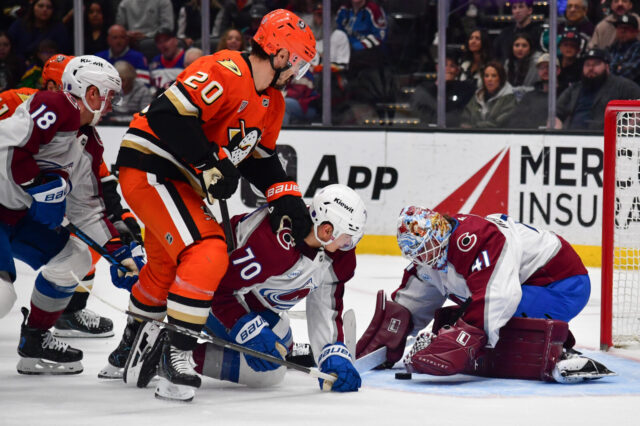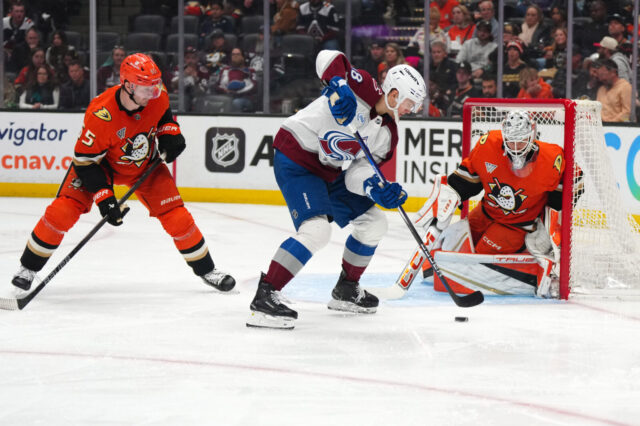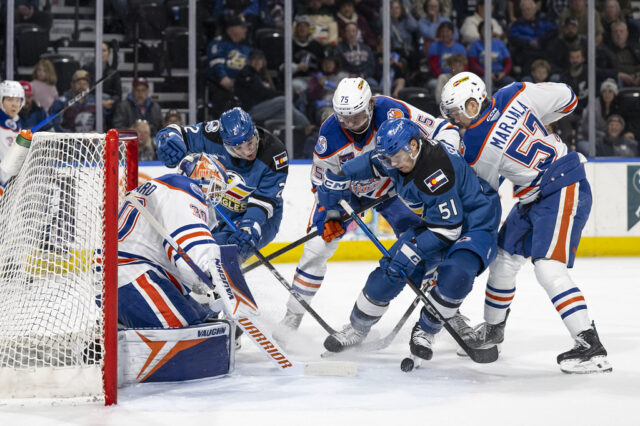

As a sports enthusiast, I often get nervous when my team starts off hot right out of the gate. Whether looking at a specific game or the entire season as a whole, explosive success too early often backfires. How many times has a hockey team taken an astonishing three-goal lead in the first ten minutes, only to take their foot off the gas and end up losing the game? Or how often has an NHL team started out dominant and won the President’s Trophy only to fall apart in the playoffs? (2019 Tampa Bay Lightning and 2023 Boston Bruins come to mind.)
If a team starts out too strong, they have nowhere to go but down. On the other hand, if they face some adversity early in a game or in the season, they’re more likely to rally when it matters most.
If not at the start of the season, then when?
For hockey teams, rallying when it matters most means hitting their stride in January. The right players and plan can help teams overcome almost anything that happened in the first half of the season in the second half. Just look at the 2019 St. Louis Blues — in last place in the league in December. Then, they made some changes at exactly the right time and ended up winning the Stanley Cup. But if a team starts out firing on all cylinders, maintaining that pace and energy can be difficult. Which is why, when the Colorado Eagles started their season way out in front of the rest of the AHL, I was nervous.
Nowhere to go but down.
And now, just two weeks into January, it indeed appears that the wheels may have come off the bus.
What’s changed?
For the first part of the year, the Eagles ranked at the top of the Pacific Division, and in the top three of the Western Conference. But since turning the page to 2026, the Eagles have played seven games — three on the road and four at home. In that time, they’ve gone 2–2–1–2. This week, they hosted the Ontario Reign (LAK) at home and lost both games, one in regulation and one in a shootout. As a result, the Eagles now lag two points behind the Reign in the Pacific Division standings.
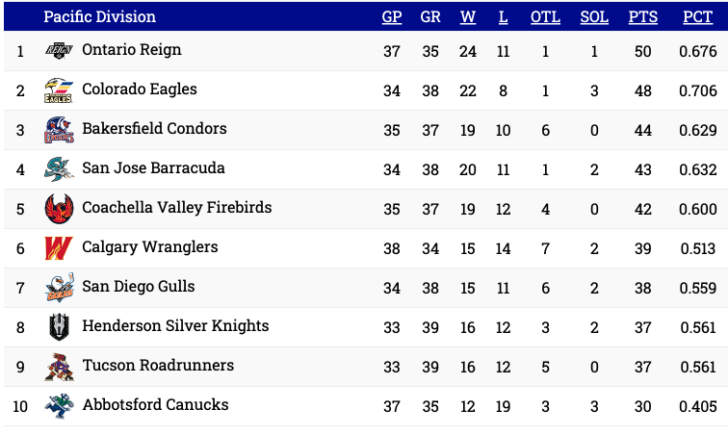
Colorado’s season overtime record is 4–1–1–3. But since January 1, their overtime record is 0–1–0–2, meaning that three of their four overtime or shootout losses (and none of their overtime or shootout wins) have happened in just the last seven games.
What exactly is leading to this decline? There are several contributing factors, but of those, two stand out.
The Problems:
Foremost, just like in the NHL, injuries can derail any train. A partial list of players who have missed time this year because of injury includes Danil Gushchin, Cooper Gay, Jason Polin, Chase Bradley, and Hank Kempf. And in the AHL, lineups are always fluid. Injuries to Avalanche players almost always mean that some of the Eagles’ top players will be called up. Losing Eagles players means calling up reinforcements from the ECHL. All of which results in a slightly less skilled group of players on the ice.
Second, the Eagles’ special teams have struggled recently. I mentioned this in my most recent Stat Tricks column, but things have devolved even further since then. Looking back to November 21, 2025, the Eagles ranked second in the AHL for both power play and penalty kill, coming in at 29.2% on the former and 88.5% on the latter. As of January 15, they have fallen to tenth on the power play at 21.6%, and eleventh on the kill at 82.5%.
But that’s only part of the picture.
Looking at just the games so far in 2026, the Eagles are at only 14.3% with a man-advantage, and 71% on the kill. Comparing those numbers to the overall special teams percentages in the league, the most recent stats would put Colorado in 28th place for the power play, and dead last for the penalty kill.
Of the Eagles’ five losses in 2026, four of them were one-point games. All were games in which the Eagles had zero power play goals. And all were games where the Eagles allowed at least one power-play goal to be scored against them. A single power-play conversion in any of those four games could easily have meant a win instead of a loss. An additional stop on the penalty kill could have done the same thing.
And in the one loss that wasn’t a one-point game, the Eagles’ 6–3 drubbing by Ontario on Tuesday? The Eagles had three power-play chances. They also gave up one power-play goal to Ontario. A change in either of those categories might have turned the tide.
In short, the power play and the penalty kill both need to improve. Those kinds of numbers won’t take the team far in the playoffs.
Is it time to panic?
Of course not. It’s only January, and yes, there’s still plenty of hockey left to play. The last seven games have been demoralizing, but it’s not quite time to hit the alarm yet. Head coach Mark Letestu said recently that the team knows what needs to be done.
We’ve got to close out games. We’ve had some leads lately, they’ve gotten away on us. We’ve given away points because of it. So for me, I’ve got to find some players that are going to do the right things down the stretch and close out some games and get some wins. At the same time, they know it’s unacceptable to lose at home… We’re not a moral victory team. We’re here to win hockey games. We’re disappointed about it. We’ll take some positives, but you know, we’ve got to be better. We’ve got to win those games down stretch.
Conclusion
The team cannot do much about injuries. The job of any team is to fight through those types of obstacles. But on special teams, the Eagles will need to score power-play goals again. And, maybe more importantly, they need to be better on the penalty kill. Otherwise, they may end up fighting for the sixth or seventh Pacific Division seed rather than enjoying a bye week and home-ice advantage in the playoffs.